
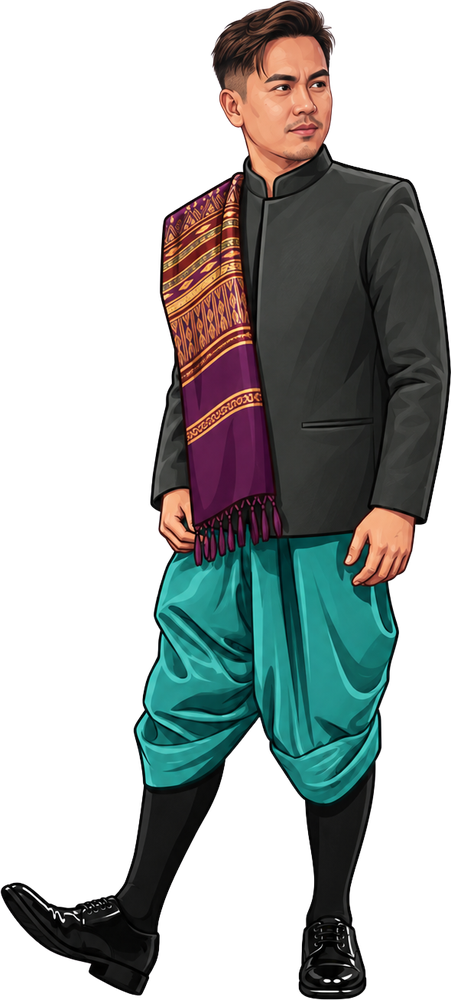
Everything I do is the same job. It took me about thirty-five years to notice.
I cook, I write about Buddhism, I keep a record of Lao culture, and I put on weddings. On paper that is four careers held together by nothing. In practice it is one instinct with four rooms to stand in, and the instinct is this: make something good enough that a person will accept what is inside it.
That is hosting. I learned it from three women before I could tie my shoes.
My grandmother on my mother's side lived with us and babysat me, and she made things. Every Buddhist holy day there were arrangements to build for the altar, and in Laos those would have been banana leaf and chained flowers, but we were in Virginia and there were no banana leaves at the Safeway. So she cut leaves out of gift wrap. She strung craft-store beads where the flower chains should have been. When she needed glue she boiled starch on the stove until it went tacky, and I sat next to her while she did it.
I was an inquisitive kid and a hands kid — I liked knowing how a thing came apart and whether I could put it back differently. So I watched, and then I helped, and then I was doing it.
What I did not understand until recently is what she was actually getting out of it. She was calm in a way she was not calm the rest of the week. Hours of careful repetitive beautiful work, alone with her hands, with a reason to sit still that nobody could argue with because it was for the temple. That is meditation. Nobody in that house would have called it that.
My father's side came from Luang Prabang and did everything with more pageantry. They ran a real operation — arrangements delivered to temples across the province every holy day, the biggest weddings, the parties everybody talked about. Every year my grandmother on that side held a baci for herself, calling her thirty-two khwan back and asking forgiveness of the people she owed it to. The paper baci set came out of storage once a year like a Christmas tree, and I was excited every single time.
And my mother sold food out of a car.
She was the Lao food lady for Northern Virginia, DC and Maryland, and she still is. Jerky, sauces, pickles, whole trays of things, taken to temple events and house parties, and after the ceremony ended and the music started she would send me out to the parking lot to carry it in. I was mortified every time. She was never mortified once. She had nine children to think about and she was extremely good at what she did.
She had learned in the hardest place a person can learn. Before I was born, in a refugee camp in northern Thailand, she worked a sukiyaki stall — and the seafood sukiyaki I still cook is her recipe, worked out there, to help keep the family fed. She cooks like an inventor. Always someone else's ingredient in her hand, always working out how to bend it toward a Lao flavour. Nothing measured, ever.
Three women, one method. Make the beautiful thing. Bring it to people. Do not explain yourself.
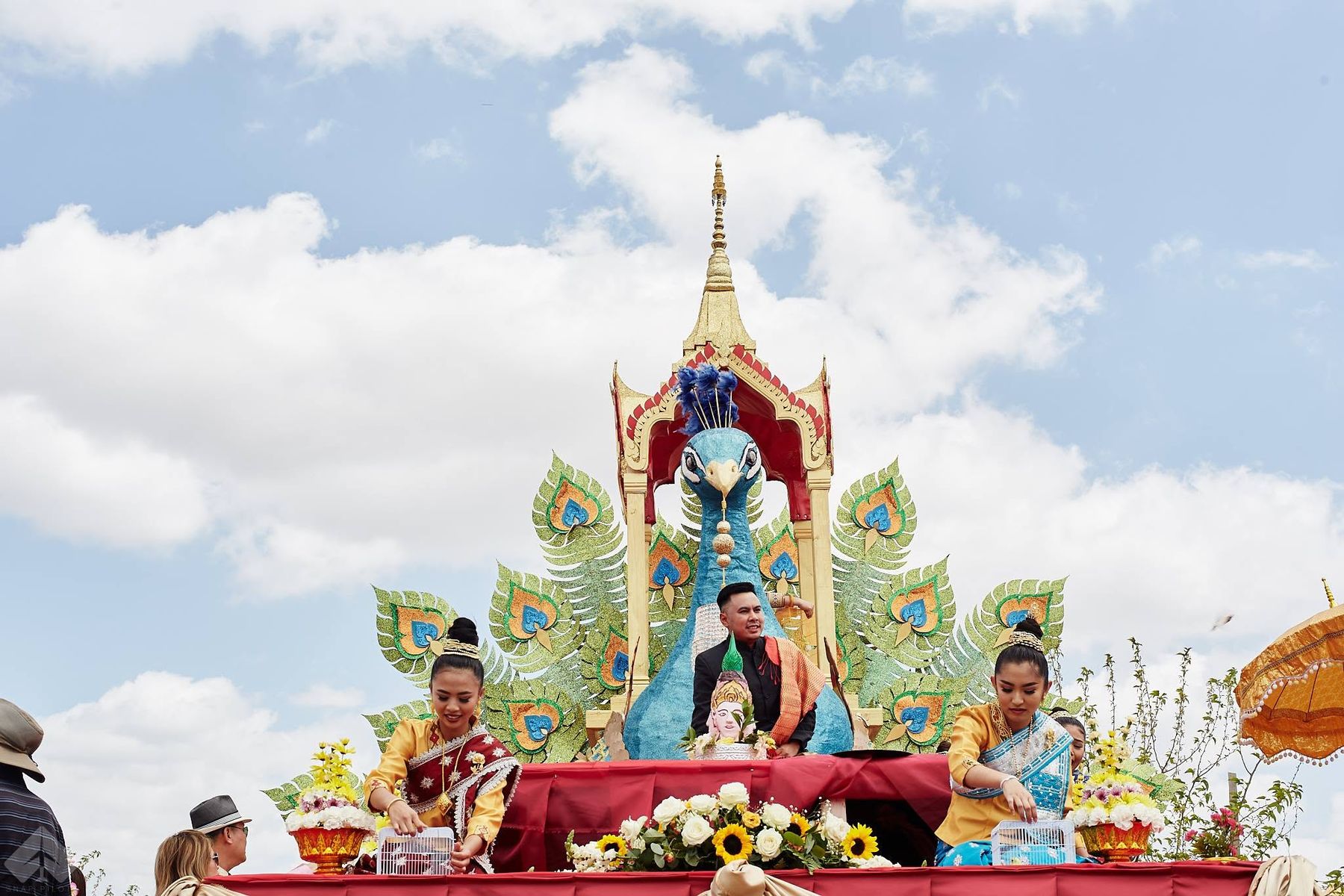
I got good at the crafts young enough that my grandmother started asking me to make hers. Then a cousin wanted one for a wedding. Then someone else's wedding. Then I was dressing brides, and then working out the groom's procession, and then house blessings, and then whole festivals.
It expanded because I could not stop asking why. Why this many candles. Why that direction. Why the thread on the left wrist. I went to monks, I went to elders, I sat at the temple most weekends of my life, and eventually people stopped asking each other and started asking me. By my thirties I was one of the people you called about Lao culture in this country. Film sets hired me. I consulted for Netflix. Disney Animation brought me onto the lot to perform a baci.
And I want to be honest about what that was for me at the time. It was identity. It was the thing that made people see me. I was the Lao culture guy, and I liked it, and there was ego in there that I would not have admitted to.
Here is the part that took me twenty years to see. I could run any ceremony in our tradition better than almost anyone alive, and I did not understand Buddhism at all.
What I had was ritual. Perfect ritual. And underneath the ritual was a transaction — do this, get that; give here, get merit; be good, be rewarded. No god in it, and somehow still an account being kept above my head.
One person handed me something real and neither of us knew it. Ajahn Khamvanh Phimmavong looked after me when I was a novice and taught me to sit. I had no idea what I was doing or what it was for. He did not walk me down the path. He sat me on it, and then it took me about twenty years to stand up.
I moved to Los Angeles at eighteen and got homesick. Not for a place. For a taste.
There was no Lao food here then. There still is not much. And even when I found some, it did not taste like hers, because nobody cooks like my mother.
So I cooked from memory. Asking her for a recipe was useless — no measurements, and the instructions came out as a beautiful mess I would get a headache trying to write down. So I stopped writing them down and started treating them as clues, filling the gaps with recipes off the internet and technique off television. Nobody could afford cable, so everyone watched Food Network. Most people watched it. I took notes.
The first khao soi I ever made, I had never eaten khao soi. Not once. I built it out of my mother's description and a guess.
Flavour came from her. Technique came from TV. The rest was craving.
By my twenties I was living at ground zero in West Hollywood with a standalone guest house and a decent patio, and my place was the pregame and the after-party every weekend. I have always loved hosting — I came up in high-end guest service and event design, so feeding people was reflex. And I was paying for Lao cultural work out of my own pocket, badly. So I started asking friends for a few dollars for the food.
I had no idea that was a pop-up. I did not know pop-ups existed. It was a fundraising scheme with good food.
Then my mother's beef jerky became a business.
It was the thing my friends always asked me to have shipped from her. Eventually I asked for the recipe. She gave it to me, I made it myself, and it came out close enough that the orders did not stop. Dehydrators running around the clock in my garage, alarms set through the night so I could get up and flip the trays. Last thing I checked before bed. First thing I checked in the morning. I quit my job for it. People say a business is their baby — I fed that thing before I fed myself.
Then I took a partner, and it ended, in a lawsuit. I am not going to relitigate any of that here; he is a person, not a villain, and this is not the place for it.
What was left was no income, no business, and a real possibility hanging over me for months that I would be found guilty of a felony for something I did not do.
I came apart.
Drinking stopped working, because it turned the volume up and the next morning was worse. I could not watch films or listen to music — entertainment is manufactured emotion, and I had nothing left to filter it with, so whatever a song was built to make me feel I felt at full blast, by myself, in a car. I drove for Lyft and Instacart to keep the lights on. Many hours alone.
And I was furious at Buddhism specifically. I had given that temple my entire youth. I knew every chant, every offering, every ritual, I performed them better than anyone, and none of it came when I needed it. I was not suicidal, but there were months where I wanted to be gone. I say that plainly because somebody reading this is in it right now. It passed. It took a while. It passed.
And if that is where you are right now — please talk to someone qualified first. In the US you can call or text 988, the suicide & crisis lifeline, any time, free. Nothing on this page is a substitute for real help.
What moved it was an accident. I kept YouTube running while I drove — talk shows, podcasts, sometimes a dhamma talk — not listening to any of it, just not wanting to be alone with myself. One day a music video came on and I actually looked up. It was Patachara, though I did not know that yet: a woman who lost her entire family in a single night and came apart in public in front of everyone. I watched it twice. It was not faith. I did not trust it. I just recognised her.
That sent me looking, and I found a talk on her story by Ajahn Sompop Chothipañño, who had been in my feed for years because he speaks about Lao tradition. He talked about meditation. And I thought — alright. It worked for her.
Sitting still had never worked for me, so I made it a game. Count to a hundred without losing the number. Lose it, start over.
That was the entire practice. But I was too busy counting to be miserable, and after a while I noticed that the misery came and went. It was not solid. It was not permanent. Nothing is, including the thoughts insisting otherwise.
My grip loosened. My head cleared. I decided I had not done anything wrong, got a new lawyer, and worked gig shifts to pay for one. And because I felt well enough to take care of myself again, I started cleaning. I cleaned the garage.
In the garage was a grocery bag of receipts and invoices — hundreds of them, nearly every transaction I had been accused of. I could account for all of it. A week before we went back to court he offered to settle for the business, and I signed it over gladly, because by then it was mostly debt.
People talk about miracles. I do not really believe in them. But the miracle was not the bag of receipts. The miracle was being well enough to clean the garage.
And what I found underneath all of it was the thing I had been standing next to for thirty years without once seeing.
The objective was never merit. It was never good karma, or being watched by something keeping score. Those come along with the practice, but they are not the point. The point is the end of suffering. That is all it ever was.
That changed what the cultural work was for me.
Before, it was who I was. I would have been nobody without it, and some part of me knew that and held on tight. Afterwards it was not. My practice went past needing it. Everything ends; Lao culture will end; I will end, and holding on to any of it is exactly the grip the whole teaching is about loosening.
I kept doing it anyway, for a completely different reason. Some things carry enough value that they are worth keeping around as long as possible — especially for the people who have not got anything out of them yet. That is not attachment. That is just a decent thing to do with your hands while you are here.
So: four rooms.
Eat Yum Sະlut is the food. Lao refugee food specifically — not what is eaten in Luang Prabang, but what my family made after they left, with the wrong ingredients and the right memory. Pop-ups, markets, catering, chili oil, and cooking at your table. Everything I cook lives there.
Life is Buddhafull is the dhamma, in plain language, from a practitioner and not a teacher. It exists because I found this by accident, through a YouTube algorithm, at the worst hour of my life, and that is a terrible way for something this useful to reach anybody.
Mahoraan is the record — Lao arts, tradition, custom and belief, including the parts that are already gone. Because almost nothing large has disappeared, and an enormous amount has quietly gone missing inside things that still look whole.
And here is weddings and events, which is where I started and the only thing I still do under my own name. Rooms, ceremonies, processions, the whole shape of a day.
Four doors into one house.
If you want the thing underneath all of it, here it is.
I think a great deal of Lao tradition is mental health infrastructure, and that nobody has said so out loud.
The baci calls your spirits back when life has scattered you. The holy days were mandated rest — days you were required to stop, and required to stop harming. The temple weekend was elder care and a social calendar and a support group before any of those things had names, and the women who filled it lived long, stayed sharp, and were never lonely on a Saturday. The crafts are meditation nobody had to sell you as meditation.
Our ancestors built all of that deliberately. It looks like decoration and it is not.
And most people my age and younger have been handed the packaging and never the thing inside it. Not because anyone failed them. Because the generation that carried this out of a war carried the shape of it, which was all anyone could carry, and the shape was home.
My work is putting the inside back.
Food is how I get in the door, because you cannot approach a stranger about cultural preservation and keep their attention for more than nine seconds — but put something extraordinary in their mouth and they will ask where it came from, and then where Laos is, and then what the music sounds like.
There is a question chefs ask. Not is it good — anyone can tell you that. How does it eat. How does it actually feel, in the hand, in the mouth, in the room, for the person receiving it.
I ask that about everything. A dish, a ceremony, a website, a wedding, a paragraph about Buddhism. What is the experience of receiving this. That is the entire job, and it is the same job my grandmother was doing when she cut leaves out of gift wrap because there were no banana leaves in Virginia.
Make the beautiful thing. Bring it to people. Do not explain yourself.
I am explaining myself once, here, so that I never have to anywhere else.
The four doors
- Eat Yum Sະlut ↗ Lao refugee eats. Pop-ups, catering, chili oil, and dinner cooked at your table.
- Life is Buddhafull ↗ Theravada Buddhism in plain English, from a practitioner.
- Mahoraan ↗ A record of Lao culture. What survives, and what didn't.
- Weddings & events Ceremonies, receptions, and the shape of a day.